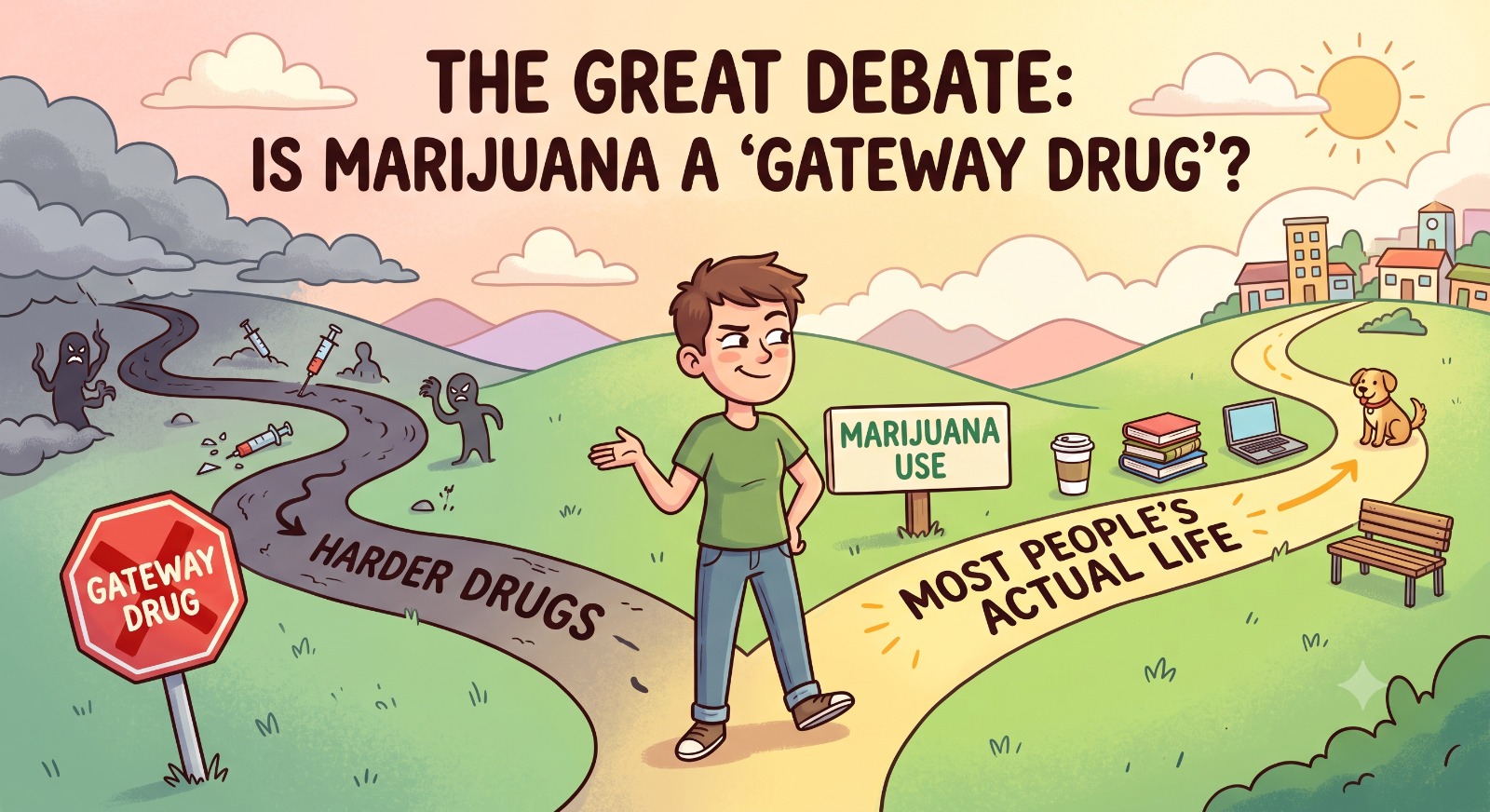
The Great Debate: Is Marijuana Actually a "Gateway Drug"?
Let's face it: if you grew up in the 80s, 90s, or even the early 2000s, you probably heard the classic warning. “Try marijuana once, and the next thing you know, you’ll be making terrible life choices in a dark alley.” It’s the infamous "gateway drug" theory. But does lighting up actually open a magical, unavoidable portal to harder substances?
Let’s break it down, minus the scare tactics.
The Short Answer? Not Really.
According to the National Institute on Drug Abuse (NIDA), the vast majority of people who use marijuana do not go on to use other, "harder" substances. Most folks who enjoy cannabis stick exclusively to, well, cannabis.
Correlation Isn’t Causation
So, where did this pervasive myth come from? It stems from a sneaky little logic trap. Yes, many people who use hard drugs did try marijuana first. But you know what else they probably tried first? Alcohol. Nicotine. Caffeine. Milk!
Marijuana is relatively cheap and widely accessible. Because it’s often the easiest substance to get your hands on, it naturally becomes the first one curious people try. This means the connection is mostly about availability and social circles, not because weed fundamentally rewires your brain to crave entirely different, heavier chemicals.
The Real "Gateway"
If there is a gateway to harder substances, science suggests it has much more to do with your environment than your lungs. Poverty, genetics, untreated mental health struggles, and hanging out with a crowd that actively uses heavy drugs are far bigger predictors of future substance abuse than taking a hit from a joint.
The Bottom Line
Is cannabis entirely risk-free? Of course not. It can still be habit-forming for a small percentage of people, and experts agree it isn't great for developing teenage brains. But is it a guaranteed, one-way ticket to a life of hard drugs? Absolutely not.
You can officially put the "gateway drug" myth to bed, right next to those dusty, vintage D.A.R.E. t-shirts.