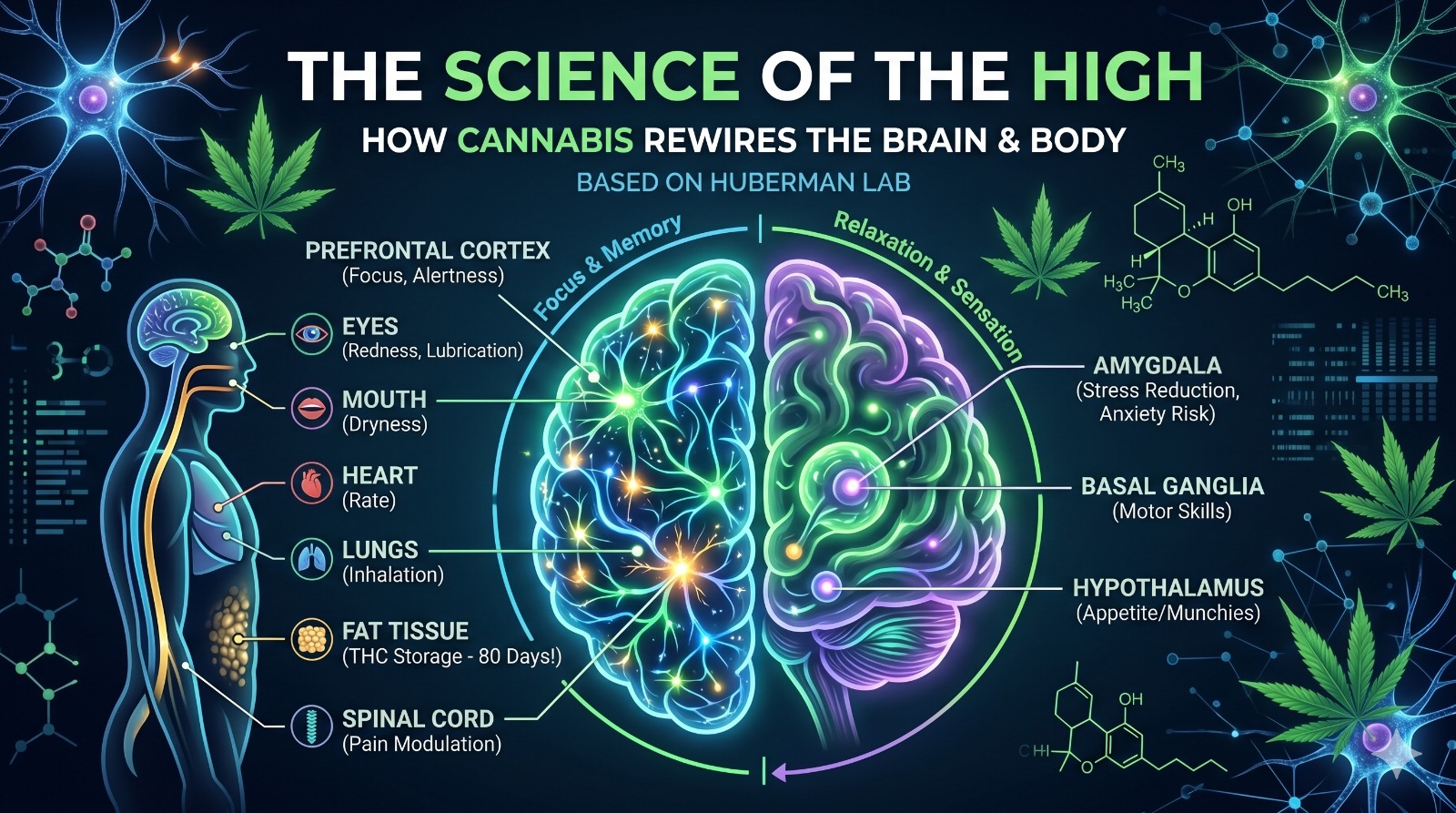
The Biology of the High: How Cannabis Rewires the Brain and Body
Marijuana has evolved from a counterculture staple into a mainstream, highly commercialized phenomenon. Yet, despite its widespread use, few truly understand what happens under the hood when active compounds enter the human system. In a masterclass breakdown, neurobiologist Dr. Andrew Huberman sheds light on the rapid, complex, and often unpredictable ways cannabis interacts with our neural circuitry. Whether you ingest it or smoke it, the science behind the "high" is a fascinating tug-of-war within the brain.
The 30-Second Fast Pass to the Brain
Cannabis doesn’t take its time. Unlike other substances that navigate slow metabolic pathways, the psychoactive components of cannabis, primarily THC and CBD, are incredibly lipophilic (fat-loving). Because every neuron in the body is wrapped in a protective fatty membrane, these compounds pass through cellular barriers with effortless ease.
When smoked or ingested, cannabis enters the bloodstream and permeates the brain and body within a mere 30 seconds. Its biological and psychoactive effects peak between 30 to 60 minutes and typically last anywhere from three to four hours.
However, because these molecules bind so tightly to fat tissue, they are notoriously stubborn to clear. Dr. Huberman notes that THC and CBD can linger in the body's deeper fatty tissues and remain detectable for up to 80 days after consumption, and simply losing body fat won’t instantly flush them out.
The Neural Seesaw: Sativa vs. Indica
The ultimate effects of cannabis rely heavily on its interaction with CB1 receptors, which are densely packed throughout our neural circuits. Depending on the strain and the individual, the active compounds can either act as an accelerator or a brake on the nervous system.
Sativa (The Hyper-Focused Head High): Typically associated with elevated mood, alertness, and talkativeness. Sativa varieties tend to ramp up CB1 receptor activity in the prefrontal cortex (the area right behind your forehead responsible for planning and focus). Simultaneously, it pulls back the reins on the amygdala, the brain's default threat-detection center [05:44]. This unique "seesaw effect" narrows your focus and dampens stress, pushing users into deep states of concentration, whether they are writing poetry or simply hyper-focusing on a movie.
Indica (The Sedative Melt): Known for its deeply relaxing properties, Indica does the opposite. Instead of activating the prefrontal cortex, it actually suppresses it, effectively "turning off" relentless thinking, planning, and daytime stress to help facilitate sleep.
The Great Predictability Problem (And the "Dorm Room Lore" Myth)
One of Dr. Huberman’s most crucial warnings is that cannabis effects are highly unpredictable. While one person might experience profound relaxation and creativity from a specific strain, another might experience crippling anxiety and paranoia from the exact same dose .
Currently, science has no way to predict how your unique neural architecture will react to cannabis. Furthermore, Huberman aggressively debunks a piece of common "dorm room lore": the myth that if cannabis makes you paranoid, you simply need to smoke more to push past it. In reality, cannabis potentiates its target systems; consuming a higher dose when anxious will almost categorically amplify the paranoia and panic.
The Universal Side Effects: Memory, Mobility, and the Munchies
No matter the strain, hybrid, or ratio of THC to CBD, there are several universal physiological shifts that occur when cannabis binds to the nervous system:
Final Thoughts on Pain Relief
While cannabis is widely celebrated for its medicinal properties, Huberman points out that its relationship with pain relief is unique. While it does bind to receptors in the spinal cord to blunt physical pain pathways, a massive portion of its "anti-pain" efficacy actually comes from a perceptual shift. Rather than physically erasing the pain entirely, cannabis narrows the user’s cognitive focus, allowing them to psychologically distance themselves and focus on things other than the discomfort.
Ultimately, the cannabis plant houses powerful, fast-acting compounds that effectively hijack existing signaling systems in our brains. Understanding the science behind it proves that the human brain on cannabis is a highly complex web where one molecule can pull the levers of memory, mood, movement, and appetite all at once.
Watch full Video on - youtube.com/watch?v=UCbqfBAhmPY&t=45s